
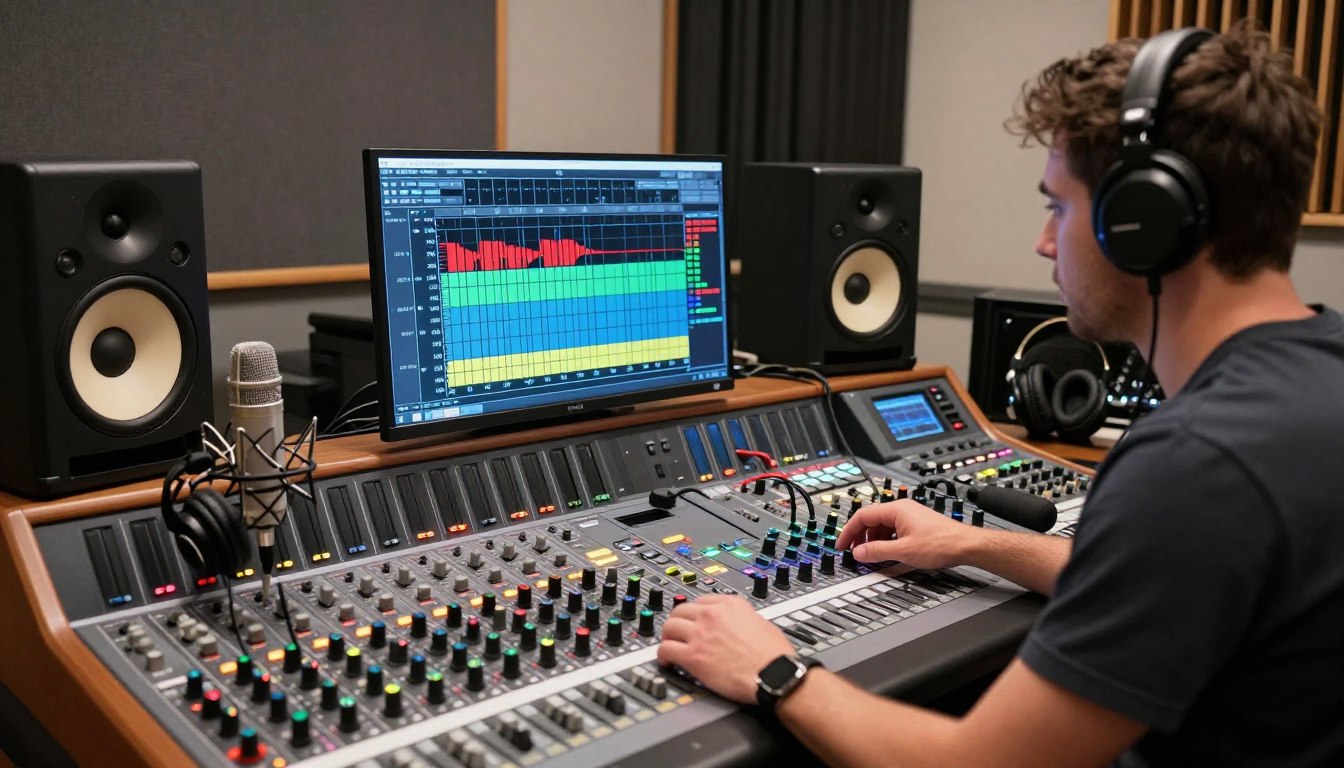
Understanding audio loudness measurement is crucial in today’s music production landscape. With the rise of streaming platforms, ensuring your content translates well across different platforms is vital. LUFS (Loudness Units relative to Full Scale) has become a key metric in achieving this goal.
Producers and audio engineers must grasp the concept of loudness measurement to optimize their tracks for various platforms. By doing so, they can ensure their music is presented consistently, regardless of the playback system. For more information on optimizing your tracks, check out our guide on practical steps to evaluate and improve generated.
Key Takeaways
- Understanding LUFS is essential for audio producers.
- LUFS helps ensure consistency across different playback systems.
- Optimizing tracks for various platforms is crucial.
- Using meter plugins can help monitor RMS and crest factor.
- Maintaining stable LUFS across tracks is key to consistency.
What Are LUFS? Understanding the Basics
The world of audio production is shifting towards a more nuanced understanding of loudness, thanks to LUFS. As a measure of audio loudness, LUFS has become a critical metric in the industry. “LUFS is not just another technical term; it’s a game-changer in how we approach audio production,” says a leading audio engineer.
Definition and Purpose of LUFS
LUFS, or Loudness Units relative to Full Scale, is a standardized measure that reflects how humans perceive loudness. Unlike other measurements, LUFS takes into account the dynamic range and frequency response of the human ear. The primary purpose of LUFS is to provide a consistent and reliable way to measure the loudness of audio content. For those starting out in YouTube music channels, understanding LUFS is key to ensuring your content meets platform requirements.

The use of LUFS has become widespread across the audio industry, from broadcasting to streaming services. It helps in maintaining consistency across different types of content and platforms.
How LUFS Differs from Other Audio Measurements
LUFS differs significantly from other audio measurements like RMS (Root Mean Square) and Peak. While RMS measures the average power of an audio signal, and Peak measures the maximum level of the signal, LUFS provides a more accurate measure of perceived loudness. As noted by audio experts, “LUFS is more aligned with how we hear the world around us, making it a more human-centric measurement.”
By understanding LUFS, audio professionals can better manage the loudness of their content, ensuring it meets the requirements of various platforms and enhancing the listener’s experience.
LUFS Explained: The Technical Side
To comprehend LUFS fully, it’s essential to explore the science behind loudness measurement. Loudness is a subjective measure that depends on the human perception of sound. Unlike peak level or RMS (Root Mean Square) measurements, which provide objective measures of signal amplitude, LUFS takes into account the way our ears respond to different frequencies.
The Science Behind Loudness Measurement
Loudness measurement is based on the human auditory system’s response to sound. Research has shown that humans perceive certain frequencies as louder than others, even when their amplitude is the same. LUFS measurement algorithms are designed to mimic this response, providing a more accurate representation of how loud a piece of audio sounds to the human ear.

Types of LUFS Measurements
There are three primary types of LUFS measurements: Integrated, Short-term, and Momentary. Each provides a different insight into the loudness characteristics of an audio signal.
Integrated LUFS
Integrated LUFS measures the overall loudness of an entire audio program, from start to finish. It’s a single value that represents the average loudness of the entire piece, making it useful for comparing the overall loudness of different tracks or programs.
Short-term LUFS
Short-term LUFS measures the loudness over a shorter period, typically a few seconds. This measurement is useful for understanding the dynamics of an audio signal and how loudness varies over time.
Momentary LUFS
Momentary LUFS measures the loudness over an even shorter period, usually around 400 milliseconds. This provides insight into the very short-term loudness characteristics of an audio signal, which can be useful for identifying transient loudness peaks.
Understanding these different types of LUFS measurements is crucial for audio professionals, as it allows them to make informed decisions during the mixing and mastering process. By considering both the overall loudness and the short-term dynamics, producers can create mixes that are well-balanced and competitive on various playback platforms.
Why LUFS Matter in Modern Audio Production
In the era of streaming, LUFS has become a critical factor in ensuring a consistent listening experience for audiences worldwide. The shift towards loudness normalization has significantly impacted how audio content is produced and consumed.
The Loudness Wars and Their Impact
The loudness wars, a phenomenon where recordings were mastered to be as loud as possible, have had a lasting impact on the music industry. This practice led to a degradation in audio quality, with many tracks suffering from dynamic range compression. The loudness wars were driven by the desire to make songs stand out on the radio, but they ultimately resulted in listener fatigue and a less enjoyable listening experience.
The move towards LUFS-based normalization has been a response to the loudness wars. By standardizing loudness levels, LUFS ensures that audio tracks are played back at a consistent volume, regardless of their original mastering level. This has revolutionized the way producers approach mixing and mastering, allowing for a focus on dynamic range and audio quality rather than just loudness.
Streaming Platforms and Loudness Normalization
Major streaming platforms such as Spotify, Apple Music, and YouTube have adopted LUFS standards for loudness normalization. For instance, Spotify uses a target LUFS level of -14 LUFS for its normalization. This means that producers can now focus on creating high-quality mixes without worrying about their tracks being too quiet or too loud compared to others. For more information on how to optimize your audio for streaming platforms, you can check out this step-by-step guide.

The adoption of LUFS by streaming platforms has not only improved the listening experience but has also influenced production practices. Producers are now more inclined to focus on the artistic aspects of their work, such as dynamics and mix balance, rather than trying to make their tracks as loud as possible. This shift has led to a more nuanced and enjoyable audio landscape.
How to Measure LUFS in Your Projects
To ensure your audio projects sound their best, understanding how to measure LUFS is essential. Measuring LUFS is a critical step in achieving consistent loudness across your audio productions, whether you’re working on music, podcasts, or video content.
Essential Tools and Plugins for LUFS Measurement
To measure LUFS, you’ll need the right tools. Several plugins and software solutions are available for LUFS measurement, including FabFilter Pro-L2, iZotope Ozone, and TC Electronic LM2. These tools provide accurate LUFS readings and help you adjust your audio to meet the required loudness standards.
When choosing a LUFS metering tool, consider the type of projects you work on and the specific loudness standards you need to adhere to. For instance, if you’re working on music production, you might prefer a plugin that offers both LUFS metering and limiting capabilities.

Step-by-Step Guide to Measuring LUFS
Measuring LUFS involves a few straightforward steps. First, you’ll need to set up your metering tools. Then, you’ll interpret the LUFS readings and make necessary adjustments to your audio.
Setting Up Your Metering Tools
To start measuring LUFS, insert your chosen metering plugin into your master track. Configure the plugin to display LUFS measurements according to the relevant standard, such as EBU R128 for European broadcast or ATSC A/85 for North American broadcast.
Interpreting LUFS Readings
Once your metering tool is set up, you’ll need to interpret the LUFS readings. Pay attention to the integrated LUFS value, which represents the overall loudness of your track. For streaming platforms, target a loudness level between -14 LUFS and -18 LUFS, depending on the platform’s requirements.
Making Adjustments Based on Measurements
After interpreting your LUFS readings, make adjustments to your mix as needed. This might involve using a limiter to prevent loudness peaks or adjusting the overall gain to achieve the desired LUFS level. For more information on optimizing your audio for different platforms, check out our guide on best AI music prompts.
| Platform | Recommended LUFS |
|---|---|
| Spotify | -14 LUFS |
| Apple Music | -18 LUFS |
| YouTube | -14 LUFS to -18 LUFS |
LUFS Standards and Target Levels
As the audio landscape continues to evolve, grasping the nuances of LUFS standards is essential for producers aiming to optimize their content for diverse distribution channels. LUFS standards ensure that audio content is presented at a consistent loudness level, enhancing the listener’s experience across different platforms.
Broadcast Standards
Broadcast standards for LUFS have been established to maintain consistency in audio loudness across television and radio broadcasts. Two prominent standards are EBU R128 and ATSC A/85. EBU R128 is widely adopted in Europe and other parts of the world, providing a standardized method for measuring and normalizing audio loudness. ATSC A/85, on the other hand, is used in North America, setting guidelines for loudness and true-peak audio.
These standards help prevent abrupt changes in volume during broadcasts, ensuring a comfortable listening experience. By adhering to these guidelines, broadcasters can maintain a consistent audio level, reducing the need for viewers to adjust the volume.
Streaming Platform Requirements
Streaming platforms have their own set of LUFS standards to ensure that content is optimized for their specific environments. Understanding these requirements is crucial for content creators to ensure their audio is delivered at the optimal loudness level.
Spotify (-14 LUFS)
Spotify targets a LUFS level of -14, with a tolerance range that allows for some variation. This standardization helps maintain a consistent listening experience across the platform’s vast music and podcast library.
YouTube (-14 LUFS)
YouTube also aims for a -14 LUFS target, aligning with Spotify’s standard. This consistency is beneficial for creators who distribute their content across multiple platforms, simplifying the process of loudness normalization.
Apple Music (-16 LUFS)
Apple Music, however, targets a slightly different LUFS level at -16. This difference highlights the importance for content creators to be aware of the specific requirements for each platform they distribute their content on, to ensure optimal loudness normalization.
By understanding and adhering to these LUFS standards and target levels, audio professionals can ensure their content is optimized for various distribution channels, enhancing the overall listening experience for their audience.
Conclusion
Understanding LUFS is crucial for delivering high-quality audio content that translates well across various platforms. By grasping the concept of LUFS and its measurement, audio producers and engineers can ensure their work sounds its best, whether it’s played on streaming services, broadcast television, or other media.
LUFS measurement helps maintain consistency in loudness, preventing abrupt changes that can be jarring to listeners. This is particularly important in today’s diverse audio landscape, where content is consumed on a wide range of devices and platforms.
By applying the knowledge gained from understanding LUFS, audio professionals can optimize their productions to meet the specific requirements of different platforms, enhancing the overall listening experience. This not only improves the quality of the audio but also ensures compliance with broadcast and streaming standards.
As the audio production landscape continues to evolve, staying informed about LUFS and its role in loudness normalization is essential for producing competitive and engaging content.